Showing posts with label Registered Teaching Criteria. Show all posts

Saturday, 27 June 2015

Science week

This week we set aside our usual learning plans, literacy and numeracy to engage the children in a week of hands-on science intensives. Our objectives were to learn about chemical change. So I undertook the teaching of bread making, something which I've personally been doing for years, but never really bothered to understand the chemical principals of. What resulted was in depth learning on my part, which I thoroughly enjoyed passing onto the children in years 4 - 8. 
We began the day by probing some of our prior knowledge about liquids, solids and gases and how things are formed by using this image from Cartoon Concepts: in science education about liquids. 

In particular I wanted the children to gather the understanding that whipped cream changes it's volume and shape by the whipping process where gas is added to the liquid. 
Using this diagram also enabled me to cover any misconceptions that they children had, and uncover their prior knowledge all while building their vocabulary and confidence in scientific discovery. 
Following this intro we went about making bread using Building science concepts book 56: Bread: The chemistry of bread making as a guide for my lesson planning. Refer to my gbsparker class blog post on our bread making discovery.  

I wanted the children to explore raising agents in several ways and understand that the raising occurs by a chemical reaction between the ingredients in which carbon dioxide is developed. We used baking soda, and yeast to prove this theory in several different ways throughout each morning. More so, I needed them to understand the nature of yeast being a living organism. I found a great narrative in Yet more everyday science mysteries. Stories for inquiry-based science teaching*, which supported children in exploring this concept and determine that yeast reacts differently from baking soda; requiring time and warmth to create the chemical reaction required to develop the carbon dioxide.

As a teacher the process of planning and teaching this unit reinforced the 'teacher as learner' immensely for me. Even though I thought I knew a lot about bread making, I too learned so much during this process. I enjoyed teaching it and my learners enjoyed being a part of the discovery process. 


This blogpost relates to RTC: 
4.iii) initiate learning opportunities to advance personal professional knowledge and skills. 
6.ii) Through planning and teaching, demonstrate knowledge and understanding of relevant content, disciplines and curriculum documents. 
8.i) enable ākonga to make connections between their prior experiences and  learning and their current learning activities. 
9.ii) Select teaching approaches, resources, technologies and learning and assessment activities that are inclusive and effective for diverse ākonga. 


*Konicek-Moran, R. (2011) Yet more everyday science mysteries. Stories for inquiry-based science teaching. NSTApress p. 93-97

Sunday, 24 May 2015

9 reasons to use Connected+ digital resouces

As a teacher in a digital learning environment, I also need digital resources. 
By having resources available online it means that my learners can access the material anywhere anytime not just in the traditional 9 - 3pm class time. 

Listen to +Fiona Grant, +Juanita Garden and I talk about the Connected + digital series which are available free through the TKI: Literacy Online site. 


The main things I love about Connected+ are as follows 
  1. Accessibility - Embed presentation in blogs or sites, learners can re-read any where any time
  2. Audio versions included - great for our ESL and below standard readers to access content for their curriculum level
  3. Includes video's to give further information on related topics 
  4. Includes interactive diagrams 
  5. Includes links to further learning - children's or teacher's independent research 
  6. All text images and digital content downloadable - free educational re-use with attribution (Creative Commons licence)  
  7. Available in PDF 
  8. Teacher Support Material [TSM] available in word format - edit direct into your planning. 
  9. Curriculum approved - relevant and multi-modal learning opportunities 


This blogpost relates to RTC 1.i; 4.ii; 5.i; 6.ii

Tuesday, 21 April 2015

Teaching As Inquiry

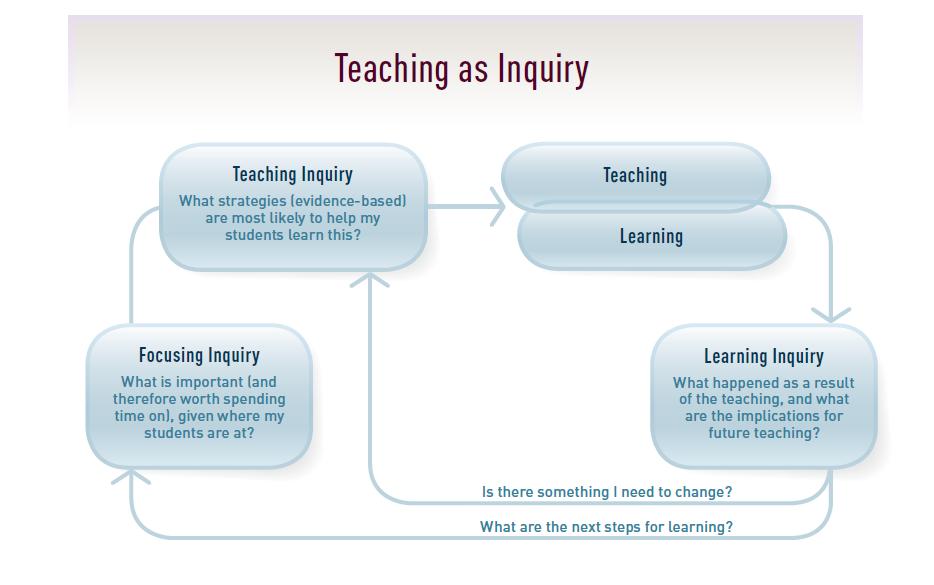
"Teaching as inquiry is a cycle of reflecting and adapting practices, based on evidence, to accelerate learning."

Today as part of our school PD we investigated Teaching as Inquiry [TAI], what it means, what it looks like and how we can go about it as a school and as individuals. 

After discussing what TAI means to us we were asked to come up with an overarching statement to define it. Above is my statement. As a school we decided to run with this statement to guide our ongoing discussions. 

"Teaching as inquiry is a cycle of reflecting and adapting practices, based on evidence, to accelerate learning."

First we explored what some of the terms within this mean. 

Evidence Evidence comes from a range of places and to engage in TAI we need to utilise a variety of pieces of evidence to adapt our practice. 

  • Research
  • Observations 
  • Children's voice
  • Teacher's voice
  • Modelling 
  • Assessments 
  • Whānau 
Adapting To adapt we have to change something, enhance it, develop, build on, and evolve. To adapt we cannot stay stagnant and we must be open to new ideas and suggestions. 

Cycle This point is the most important. Change does not just happen, and all of a sudden the learning is better. It's an ongoing cyclic process of teaching, learning, adaption, reflection and monitoring. 

Reflecting Right from the beginning, throughout and at the end of a cycle of inquiry we need to reflect. What is the area of weakness, gap or problem in the learning environment? What strategies am I currently using, and what strategies might I use in the future? What might be the implications of different strategies and continually and frequently monitoring them. 

There was also a discussion around the final part of the above statement "to accelerate learning". Whose learning? Some wanted it to say "to accelerate student learning". However student learning implies that a) children study, and b) children are the only one's learning in this situation. However to accelerate children's learning, we too as teachers must learn. This term we will be implementing 2 - 3 week cycles of inquiry in our teaching. My first inquiry is in developing children's voice in discussion during mathematics rich tasks. 

What Teaching as Inquiry have you participated in regularly?


This blogpost relates to Registered Teaching Criteria 8. demonstrate in practice their knowledge and understanding of how ākonga learn & 12. use critical inquiry and problem-solving effectively in their professional practice

Wednesday, 25 March 2015

Never underestimate....

Currently renovating our house it's important not to underestimate the cost as there are so so many little things that creep their way into the budget. Never underestimate the time this will take and the mess it will make. Those things are obvious things not to underestimate and anyone who's ever undergone any kind of DIY or home improvement can vouch for that.
When I first began my teaching career in 2013 a good friend reminded me not to underestimate children either telling me, "remember, don't think about all the things they don't know, think about all the things that they DO know." This is a true, and important thing to focus on. 

This year as I am in my second year of teaching, with new learners, teaching a new age range, and to learners who are new to being a digital learning environment, so NOT underestimating is more true than ever. 

Firstly, never underestimate myself. Yes, I am new(ish) at this game, but I am capable, competent and doing it. Doing it well, most of the time. I think sometimes as a PRT (provisionally registered teacher) we place a lot of pressure on ourselves to do everything, perfectly, right now. It's true. I want to be up to date on everything, totally organised and know exactly where my learners are at, where they need to be and how to get them there. 

As I completing my student profiles and learning needs today I realised that, no I may not know everything immediately, but I do know how to find out and how to use their assessments and information available. I need to stop underestimating myself as a teacher. And as a learner. 

This year, also undertaking my post graduate in education, I need to stop underestimating my ability to study, teach and learn simultaneously. Yes, it is challenging, but not impossible.

Secondly, never underestimate the tamariki. Sure they may be below national standard, or unsure how to do something in particular. They may be shy and quiet. They may be messy and chaotic. But never underestimate a child. This year has shown me this time and time again. Children who impress me with a particular behaviour, an answer, a skill, a performance, a generosity, a deadline, vocabulary, remembering something, a transfer of knowledge. 

This is why I became a teacher. To see children flourish and be awesome. As we come to the end of term one, I need to remember that, never underestimate, any of them, for they will live up to my expectations. Today for example, a student who is often known for misbehaving was front row at an inter-school event and was a model citizen, helpful, polite, and caring to others. Another who can play the 'class clown' who impressed in a team building game with skills and sportsmanship. A child who struggles with mathematics, but was able to draw a diagram of the correct solution to a problem. These are the tamariki who this week have reminded me not to underestimate them, or others. 

As kaiako I need to remind my students of my high expectations, and foster their trust, respect and cooperation so that they feel willing and able to let their strengths shine. 
I believe I am doing this well in a lot of ways - as this weeks impressions have shown - and need to keep not underestimating myself and my ability to teach these amazing and talented ākonga. 

This blogpost relates to RTC 7. promote a collaborative, inclusive and supportive learning environment


Thursday, 26 February 2015

6 things to Kahoot about

Today I finally used Kahoot with my learners. I'd heard about it last year, but never given it a go until now and already I can see so much potential with this digital learning tool. 

This time used it to recap on what we had learned in the Life Education van last week. Learners were able to show their recall of information and those who didn't remember something had a way to engage with the information in a fun and exciting way.


There were several features of Kahoot which I really liked. 


  1. No student logins. Just give them a Game Pin, a digital device (smartphone, tablet, laptop or computer) and they are ready to go!
  2. It tells you if you the correct answer immediately 
  3. It stops after each question, so you can do a quick bit of teaching for those who weren't correct (or to explain what the other options actually mean). 
  4. It keeps a leaderboard telling each individual participant how close they are to the person ahead of them, great motivational feature. 
  5. You get a spreadsheet of who answered for analysis, which can be saved straight to your Google Drive. 
  6. The children love it!
Kahoot also offers a survey and discussion features which I yet to try out, but am looking forward to using. 
The only downside I have found so far is that it's only multi-choice, that aside, it's a great tool to motivate engage and learn through. 

If you're still not convinced try our Kahoot about body systems and the brain! 

Updated April 8th 2015

This term I also used Kahoot to give students time to practice using google to search for information on the internet. Previous experience shows me that learners don't know how to use keywords, merely typing their whole question or using keywords which are not related to what they want to find out. 
So I set up a current events Kahoot, that learners would need to search answers for. I prompted them to open Google search in another tab and gave 120 seconds per question to be answered. For the first few we paused and discussed who used what keywords to search, what was the most effective? 
As the quiz continued they got faster and faster at searching.  I will definitely repeat this lesson and maybe use it as a formative assessment for our next topic study. 


This blogpost relates to RTC 9.iii. Modify teaching approaches to address the needs of individuals and groups of ākonga. 

Monday, 1 December 2014

Putting the P in PB4L

POSITIVE - PROACTIVE - PREVENTATIVE 

Today we received PLD on PB4L (Professional Learning Development on Positive Behaviour for Learning) 

To encourage positive behaviour you must first identify what the problem behaviours are. Currently we have been doing this at my school, collecting data from break times and determining what the main trouble causers are. Today we also discussed what problem behaviours we experience in the classroom and discussed whether the behaviours were minor, major or crisis inducing. 
With minor being ones which the classroom teacher can handle, major which need to be escalated to senior management.

Once problem behaviours are identified the school and classroom teacher can take positive, proactive and preventative action to encourage positive behaviour for learning. 

Positive

As a teacher we can choose to react to behaviours positively. Instead react to positive behaviours and (where not major) ignore negative ones. behaviour attended to escalates in frequency. Therefore by giving attention to students when they are displaying appropriate behaviour it will encourage more of if. 

Proactive

Where negative behaviours cannot be ignored, they can be responded to proactively, rather than just reprimanding a child, a proactive approach can be taken. Often when a negative behaviour occurs it is often because they are seeking attention or avoiding something, and do not know a positive way to deal with the issue. Therefore teaching and reinforcing the positive way react to an issue is a proactive approach. Explicitly showing the positive behaviour that is expected and reinforcing it positively with praise or other tangible reward (caught being good cards, house points etc). 

Preventative 

By actively teaching and reinforcing the positive behaviour expectations (eg. How to move past one another in the classroom using "excuse me" and waiting for space, rather than pushing or shoving) it prevents the negative behaviour from occurring again as it gives students other strategies to deal with the problems that they face. 

We can modify our teaching approach by explicitly teaching the right way to behave. In doing so we are maintaining effective relationships with ākonga and developing a physically and emotionally safe learning environment. I have enjoyed the PB4L induction process as we have used the evidence from other schools and the data from our own to improve our practice and school environment. For the benefits of this to really be seen we need to ensure that all staff are on board and that there is consistency in its implementation. 

The idea of consistency was also addressed today, in the discussions of what is considered minor, major and crisis behaviour, so that we all have the same understandings. More so, so that learners also know the expectations and how to meet them. 


This blogpost relates to meeting of the following RTC: 

1. establish and maintain effective professional relationships focused on the learning and well-being of ākonga
i. engage in ethical, respectful, positive and collaborative professional relationships with ākonga

2. demonstrate commitment to promoting the well-being of all ākonga

4. demonstrate commitment to ongoing professional learning and development of personal professional practice

9. respond effectively to the diverse language and cultural experiences, and the varied strengths, interests and needs of individuals and groups of ākonga
iii. modify teaching approaches to address the needs of individuals and groups of ākonga

12. use critical inquiry and problem-solving effectively in their professional practice
i. systematically and critically engage with evidence and professional literature to reflect on and refine practice

Tuesday, 21 October 2014

Bling your Google site - adding buttons and background images

Thank you to all the attendees at todays Manaiakalani Toolkit on Blinging your site. 

We went through a step by step guide of how to update your site background/wrapper image and how to create functional buttons. 

If you missed it or need a recap, please enjoy my powerpoint presentation with step by step instructions. 


I recommend naming your Google Draws as the size and button template eg. 4cm x 4cm button template. After you download each button/image as PNG, you can adapt and edit it suit your next button. This way they end up the same size and looking swish. 

It was a pleasure to share some of my learning with others today, I look forward to learning from others in the Manaiakalani community at the next toolkit. 

Hei konā mai, ngā mihi. 

Stef


This blogpost relates to me meeting the registered teaching criterion 4 & 5. 


4. demonstrate commitment to ongoing professional learning and development of personal professional practice

ii. participate responsively in professional learning opportunities within the learning community
iii. initiate learning opportunities to advance personal professional knowledge and skills
5. show leadership that contributes to effective teaching and learning
i. actively contribute to the professional learning community
ii. undertake areas of responsibility effectively 

Wednesday, 15 October 2014

Building relationships with ākonga

This blogpost relates to Registered Teaching Criteria 1. 
1. establish and maintain effective professional relationships focused on the learning and well-being of ākonga
i. engage in ethical, respectful, positive and collaborative professional relationships with:
  • ākonga
  • teaching colleagues, support staff and other professionals
  • whānau and other carers of ākonga
  • agencies, groups and individuals in the community

I was absolutely chuffed to see this blogpost over the holidays from one of my year 8 students. 


This particular student has consistently throughout the year told herself and others that she is dumb. It breaks my heart to hear this, and I have had several discussions with her about this in attempt to build her confidence and self-efficacy. 

I explain to her that she isn't dumb because she is aware that there are things which she doesn't understand, yet. It is this understanding that will keep her inquisitive and striving to learn more. I've also been reading about how it is important to praise learners for their efforts, rather than ability. Therefore I am always encouraging her for her hard work, and focusing on the things she has done well, and how she worked hard to achieve it. This blogpost tells me that she realises this hard work is paying off and planning to keep working hard to achieve. I am so proud of her and feeling that the relationships I am building with my learners are advantageous. 

Tuesday, 10 June 2014

Promoting a collaborative supportive learning environment with understanding of how ākonga learn

This reflection related to criteria 7 and 8 of the Registered Teaching Criteria. 

Criteria 7.i. To promote a collaborative inclusive and supportive learning environment, demonstrating effective management of the learning setting which incorporates successful strategies to engage and motivate ākonga. 

Criteria 8.iii. To encourage ākonga to take responsibility for their own learning and behaviour. 

Criteria 8.iv. To assist ākonga to think critically about information and ideas and to reflect on their own learning. 

Recently, in an attempt to make students more aware of their learning outcomes and my expectations I have begun to use a variety of rubrics to aid my learners in producing quality work. Research shows me that learners are more engaged and motivated to complete a task when they believe in their capabilities (Vosniadou, 2001). I believe that engagement also occurs when students have autonomy over how and what they are learning. Moreover, Vosniadou also states that social, rather than ability grouping, has a more positive impact on learner motivation. 

Therefore during our current 'Making Waves' topic, and reading of After the Spill By Maria Gill students were given the choice from several activities to complete. 
Initially, learners read the text in their ability reading groups, scaffolding for comprehension, vocabulary and linking text with diagrams. The following day the tasks were introduced [Figure.1]


Figure.1
Learners then decided what task they wanted to participate in. I was pleased to note that majority went with what they were interested in, not just what their friends were doing. This showed me that they had an intrinsic thirst for knowledge on that, or were motivated by the type of task. Engagement & Motivation! 

Next, and this is where the fun really started to happen, in our social groups we worked with me, to develop our own success criteria in the form of a rubric. 
This allowed me to really get a grasp on what they were interested in, while coaxing the specific terminology words from them: identify, cause, explain, resources, describe... From here we not only created a rubric, but co-constructed what the outcome might look like. A plan! 

Following this, using their thinking and words I was able to determine the staggered levels of achievement for the rubric, under the categories that they prescribed. Throughout the development of the instructional rubric learners were contributing, excited and talking about their understandings. As I progress with these activities I aim to have my learners develop more of the levels of achievement for themselves. 

One of the key parts of this lesson which struck me, was one of my learners who was very engaged and contributing, was holding her head in her hands in despair at the end. "What is wrong?" I asked. She told me "See this is the problem, I have all these great ideas, and I get it, but then when I leave you, I forget it all!" I told her and I hope my hypothesis is correct, that the use of our co-constructed rubric will help her achieve the plan and goals she has helped to construct. 

The construction of this rubric is aiding my students to take responsibility for their learning, and reflect on it when they use it to self assess. Moreover, many of the criteria are around thinking centred criteria, things which Andrade's (2000) research recommends. 


Andrade, H. G. (February, 2000). Using Rubrics to Promote Thinking and Learning. Educational Leadership. 57(5) pp.13-18 


Vosniadou, S. (2001). How Children Learn. Bellegarde, France: SADAG. Retrieved from http://unesdoc.unesco.org/images/0012/001254/125456e.pdf


Observation notes received from Anne Sinclair as evidence to meeting Registered Teacher Criteria 8: 
"Relating to the akonga’s experiences so they can make connections within subject areas. By using their experiences eg. Making Waves - all can bring their own experiences to the learning and share their knowledge in a meaningful and productive way. You are constantly thinking of ways to connect the learners to the learning and you realise how important it is to provide concrete experiences to your teaching in order to demystify the learning for the class. You can see how difficult it is to move from abstract ideas without ‘seeing’ what the example looks like in real terms so the connections can be made. By using money in your Maths example you created a bridge to prior knowledge rather than just using written examples. Good to use concrete materials with these learners to give them images and more confidence to have a try at new problems. Also good to hear them talking about strategies they used and why they used them"